The person behind the tools...
I graduated nursing school in 2019 and was right off orientation when the first COVID cases started appearing. No one was ready for what came next — and honestly, that experience shaped me in ways I am still unpacking. Two years later I moved into local travel nursing — sometimes working in up to three different hospitals in the same week. Different units, different teams, different workflows, different expectations. It was a lot. And it taught me so much.
The one thing that kept me grounded was building systems.
No matter where I landed, I wanted to consistently give my best. I learned quickly that when everything around you changes constantly, systems are what keep you steady. They reduce the noise. They protect your thinking. They help you stay present when the day is loud.
When I became an NP, I approached it the same way.
I had a strong nursing foundation, a supportive team, and a practice with good structure already in place. And still — when that first full patient load hit, I was finishing notes past midnight.
Part of that was simply being new. Every patient felt like a learning experience. Honestly, many still do.
I spent a lot of time reviewing guidelines, researching, checking interactions, reading through notes, looking things up again and again during those first three months. Some of that came with simply being new. I wasn't intimidated by it — I was grateful for it. I knew it was part of the process. Every patient taught me something. Every question I had to look up became something I no longer have to now. I genuinely needed and still need that time — not just to understand the what, but more importantly the why. That's the beauty of medicine — the learning, the figuring out, the investigating, the patient that feels understood, heard, and well taken care of.
At the same time, clinic keeps moving whether you feel ready or not.
The documentation. The results. The referrals. The prior authorizations. The messages. The follow-ups. Fifteen decisions happening at once while trying to stay fully present with the person sitting in front of you. And even when coworkers genuinely want to help — and many truly do — everyone has their own workflow, their own habits, and their own full patient load to carry.
I remember moments where I had researched everything I could think of, thought through every angle I knew how to think through, and still wanted a different perspective. Not because I wanted someone else to make the decision for me — but because sometimes experience sees things that newer eyes haven't learned to recognize yet.
Sometimes you just need someone to say: "Did you think about this?" "I've seen this present differently before." "Make sure you don't miss this."
That is a difficult part of medicine to explain unless you have lived it. There is so much we don't know — and the worst part is that we don't know what we don't know.
I am incredibly grateful for every person who helped guide me through that transition. And being on the other side of it now, I also understand that many of the people trying to teach me were overwhelmed too — answering questions while carrying their own full patient load.
That experience shaped everything.
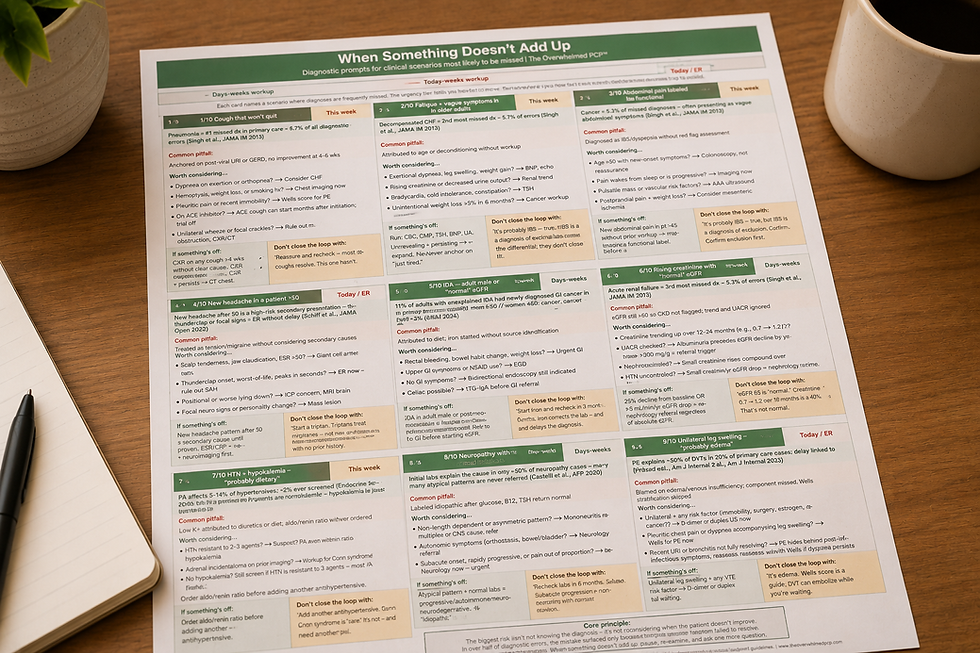
Some of these tools were built to save time and reduce mental overload. Some were built to organize the chaos of a real clinic day. Some were built because better systems create more space to think critically, keep learning, double-check carefully, and grow with confidence instead of constantly feeling behind. And some were built because sometimes we all need a second set of eyes.
What changed things for me wasn't working harder. It was building better systems.
Once I did — everything shifted. I became more efficient, more organized, more confident. And honestly, I started enjoying the process again.
These tools are what I wish someone had handed me on day one. I am still learning — six months in, every day teaches me something new and I would not have it any other way. Built for the clinician who cares deeply, asks every question they need to ask, and is figuring it out one patient at a time — just like the rest of us.
— NP MRLB
A few things I'd tell my first-week self.
Ask every question you need to ask — every single one. It is always better to ask than to stay quiet. Leave the ego at the door. It has no place here and it will only slow you down.
Build systems that work for your day, not someone else's. Ask for advice, take what resonates, and make it yours. Tweak constantly. If something feels off, it probably is. You are allowed to do this your way.
Confidence comes with time. Every provider you respect has been exactly where you are right now — overwhelmed, second-guessing, wondering if they're doing enough. You are doing enough.
You have worked incredibly hard to get here.
Be present. Breathe. Even the hard days are part of something worth showing up for.
- The Overwhelmed PCP™ -

The stuff they don't teach you in school — organized, scannable, and actually useful. Because the chaos of clinic shouldn't follow you home. You worked too hard to spend your nights finishing charts. You still have a life to attend to after the last patient walks out.